
Foodservice Packaging Supplier: Match Fit, Not Cost
A foodservice packaging supplier should do more than offer a low unit price. The right supplier should help ensure that the foodware fits your menu, order mix, service style, storage needs, and seasonal demand.
For many operators, standardizing foodware seems like the simplest way to control costs. Fewer SKUs can make ordering easier and reduce purchasing complexity.
However, foodservice rarely stays consistent throughout the year. Takeout, delivery, catering, and dine-in orders can place very different demands on the same operation.
When packaging does not match those demands, the resulting costs may appear somewhere else. Staff may spend more time handling orders. Products may require additional wrapping. Certain sizes may run out during peak periods.
Therefore, the better question may not be “Which container costs the least?”
It may be “Which foodware fits the way our operation actually works?”
What Should a Foodservice Packaging Supplier Provide?
A foodservice packaging supplier should match products to an operation’s actual menu, order mix, volume, service method, and seasonal demand. The evaluation should consider more than unit price. Container performance, sizing, availability, lead times, storage, functionality, and total operating impact can all affect the value of a packaging choice.
Why Standardized Foodware Can Fall Short
Standardization has obvious advantages.
Using fewer containers can simplify purchasing, inventory management, and staff training. A restaurant with a relatively consistent menu and service model may benefit from a limited selection of products.
The problem appears when one standardized system has to support several different order types.
Consider an operation that serves dine-in meals during the week, handles takeout every day, and accepts large catering orders on weekends. Each format creates different requirements.
A container designed around the average takeout order may not perform equally well for a large catering order. Likewise, a package designed for presentation may not provide the protection needed during delivery.
The Average Order Is Not Always the Important Order
Average volume can be useful for forecasting. It should not, however, be the only factor used to select foodware.
Peak periods can expose weaknesses that remain invisible during normal operations.
A holiday event may suddenly increase catering orders. A seasonal promotion may change the menu mix. A busy weekend may create a much higher percentage of delivery orders.
In those situations, packaging fit becomes an operational issue.
Common Signs of Poor Packaging Fit
Watch for recurring problems such as:
- Staff double-bagging or double-boxing certain orders.
- Specific container sizes repeatedly running out.
- Containers that leak, collapse, or fail during transportation.
- Excess unused space inside containers.
- Different food items requiring improvised packaging.
- Packaging purchases increasing faster than order volume.
- Frequent emergency purchases during seasonal peaks.
- Staff spending additional time assembling or securing orders.
Individually, these issues may seem minor. Repeated across hundreds or thousands of orders, they can become meaningful operating costs.
What Does “Fit” Mean in Foodservice Packaging?
Packaging fit means matching the product to the actual requirements of the operation.
That includes more than physical dimensions. The right foodware may need to accommodate the food itself, transportation conditions, service method, order volume, and customer expectations.
The National Restaurant Association’s packaging sourcing guidance specifically recommends considering factors such as what the package will contain, portion size, expected order volume, seasonal changes, temperature requirements, leak resistance, and material.
In practice, a fit-based evaluation should consider several areas.
1. Menu and Portion Requirements
A container should match the food it carries.
Saucy foods, fried foods, salads, beverages, and multi-item meals can require very different performance characteristics.
The wrong size can also create problems. Too much empty space can allow food to shift during transportation. A container that is too small can compromise presentation or cause spills.
2. Service Format
Dine-in, takeout, delivery, catering, and events do not place the same demands on foodware.
Delivery may require greater attention to closure security and transportation. Catering may involve larger quantities and more complex order assembly.
Therefore, a supplier should understand how products move through the operation before recommending a standard set.
3. Seasonal Demand
Demand rarely follows a perfectly predictable pattern.
Restaurants may experience holiday peaks, summer events, sports-related volume, convention traffic, or changes caused by promotions and menu launches.
A packaging strategy that works during an average month may not work during those periods.
4. Inventory and Lead Times
The right product still creates problems if it cannot be available when needed.
Supply reliability has become an important consideration for restaurant operators. Packaging and other imported inputs can also be affected by trade conditions and supply disruptions.
A supplier should therefore understand expected usage and lead times rather than simply quoting today’s unit price.
Fit vs. Unit Cost: What Should Operators Compare?
Unit price is easy to compare. Total operational impact is harder.
That is why evaluating a foodservice packaging supplier solely by price can create an incomplete picture.
| Factor | Cost-First Approach | Fit-Based Approach |
| Unit price | Primary consideration | One consideration |
| Menu compatibility | Often standardized | Matched to food and portions |
| Order mix | Average volume | Actual service formats |
| Seasonal demand | Reactive | Planned in advance |
| Staff handling | Secondary concern | Considered during selection |
| Inventory | Focus on current stock | Includes usage and lead times |
| Sustainability | Material-focused | Considers sizing and waste |
| Customer experience | Often overlooked | Considered where relevant |
| Long-term value | Price per unit | Overall operational fit |
The goal is not to ignore price.
Instead, price should be evaluated alongside performance and operational requirements.
Why Labor Makes Packaging Fit More Important
Packaging decisions can also affect how employees spend their time.
A container that is difficult to close, requires additional wrapping, or does not hold food securely can create extra handling steps.
That matters in an industry where labor represents a significant operating expense.
The Bureau of Labor Statistics reported a median hourly wage of $15.24 for food and beverage serving and related workers in May 2025. Food preparation workers had a median hourly wage of $16.98 during the same period.
These figures do not establish a specific labor savings from better packaging. However, they illustrate why recurring handling time deserves consideration when evaluating operational products.
Even small process inefficiencies can become more significant when repeated throughout a busy service period.
A Foodservice Packaging Supplier Should Ask Questions First
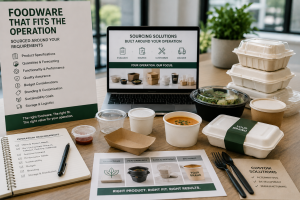
The strongest sourcing process does not begin with a product catalog.
It begins with the operation.
A supplier should understand:
- What foods will go into the package?
- What are the typical portion sizes?
- How much volume is dine-in versus takeout?
- How much delivery or catering volume occurs?
- Which seasons create the highest demand?
- What storage space is available?
- What performance characteristics matter most?
- What quantities are purchased?
- How often are orders placed?
- Are branding requirements involved?
- Are sustainability goals part of the specification?
- How much flexibility exists within the budget?
These questions help turn a generic product search into a requirements-based sourcing process.
Sustainability Should Be Evaluated Alongside Fit
Sustainability and operational performance do not have to be separate conversations.
Right-sizing can help avoid unnecessary material use. Selecting the appropriate format can also reduce the need for secondary bags, wraps, or additional containers.
However, material alone does not determine whether a foodware choice is sustainable for an operation.
A package that uses less material but fails during transportation may create another type of waste. Likewise, choosing a product that does not match actual demand can lead to excess inventory.
The better approach is to consider material, size, performance, usage, and expected volume together.
What Should You Ask a Foodservice Packaging Supplier?
Before choosing a supplier, evaluate how they approach the problem.
A strong supplier should be able to discuss more than available products and quoted prices.
Do They Understand Your Order Mix?
A supplier should know whether your operation is primarily dine-in, takeout, delivery, catering, or a combination.
The answer can influence which products make sense.
Can They Plan Around Seasonal Demand?
Ask how the supplier approaches predictable demand changes.
If your operation has major peaks, planning should happen before inventory becomes a problem.
Can They Source Beyond a Standard Catalog?
Not every requirement will have an obvious off-the-shelf answer.
A sourcing partner should be able to identify alternatives when a standard product does not meet the specification.
Can They Evaluate the Whole Requirement?
The supplier should be comfortable discussing quantity, functionality, quality, budget, branding, sustainability, storage, and logistics.
That broader view can reveal opportunities that a simple unit-price comparison misses.
The Right Foodware Is About More Than the Lowest Price
Foodservice packaging is easy to treat as a line-item expense.
However, the product interacts with multiple parts of an operation. It can affect order assembly, inventory, transportation, presentation, waste, and the customer experience.
The National Restaurant Association’s 2025 off-premises research found that 90% of off-premises customers said they would be likely to order a greater variety of food for takeout or delivery if upgraded packaging helped maintain temperature, taste, and quality.
That finding reinforces an important point: packaging performance can have consequences beyond purchasing.
The best foodservice packaging supplier is therefore not necessarily the one offering the lowest unit cost.
It is the supplier that can understand the requirements behind the purchase and help identify products that fit those requirements.
Frequently Asked Questions
What does a foodservice packaging supplier do?
A foodservice packaging supplier provides containers, foodware, and related products used for food preparation, service, takeout, delivery, and catering. A strong supplier also helps evaluate product specifications, quantities, performance, availability, and operational requirements.
How should restaurants evaluate a foodservice packaging supplier?
Restaurants should evaluate more than unit price. Important factors include product fit, order mix, seasonal demand, lead times, inventory requirements, functionality, quality, and the supplier’s ability to identify alternatives when standard products do not meet the operation’s needs.
Does the cheapest packaging always reduce costs?
No. A lower unit price does not necessarily mean lower overall operating cost. Poorly matched packaging can contribute to extra handling, double-packing, product damage, waste, or stockouts. Total value should be evaluated alongside unit price.
How often should foodservice packaging be reviewed?
A practical approach is to review packaging before major seasonal demand changes and whenever there are significant menu, service, volume, or operational changes. Regular reviews can help identify products that no longer fit current requirements.
Choose Fit Over Cost Alone
Choosing a foodservice packaging supplier should not begin and end with a price comparison.
The better approach starts with understanding how your operation actually works. Menu mix, order volume, service formats, seasonal demand, storage, labor, sustainability, and logistics can all influence what the right foodware looks like.
Direct Source Procurement takes a requirements-based approach to sourcing. Rather than treating foodware as a standardized catalog purchase, DSP can evaluate existing products, identify alternatives, source from manufacturers, or develop products around specific operational requirements.
The objective is simple: find foodware that fits the operation, not simply the lowest price on a spreadsheet.
CONNECT WITH DIRECT SOURCE PROCUREMENT to evaluate your current foodware requirements and identify opportunities for a better fit.