Sustainable packaging has become a priority across foodservice, retail, and institutional sectors. However, no matter how eco-friendly a material may be, it must still meet strict food-safety requirements. In the United States, the Food and Drug Administration (FDA) regulates all materials that come into contact with food to ensure they do not transfer harmful substances.
For businesses adopting compostable or recycled packaging, understanding FDA food-contact regulations is essential. Compliance protects consumers, reduces liability, and reassures buyers that sustainability does not come at the expense of safety.
What “Food-Safe” Means Under FDA Regulations
Food-safe packaging is defined by its inert behavior under intended use conditions. This means the material must not chemically react with food, alter taste or odor, or allow harmful substances to migrate into the food during normal handling, storage, or heating.
Materials commonly used in sustainable packaging such as bagasse, PLA, bamboo fiber, and recycled paperboard can qualify as food-safe, but only after meeting specific FDA standards. These standards evaluate purity, composition, and performance under defined temperature and moisture conditions.
Importantly, being natural or plant-based does not automatically make a material food-safe. FDA compliance depends on testing and documentation, not marketing claims.
How the FDA Approval Process Works
The FDA does not approve finished packaging products in isolation. Instead, it regulates the individual substances and materials used to manufacture food-contact packaging.
Manufacturers submit detailed information about material composition, additives, and intended use for FDA review. Once a substance is approved, it is listed under Title 21 of the Code of Federal Regulations (CFR), most commonly 21 CFR Part 177, which covers polymers and related materials.
For buyers and brand owners, the most important document is the Letter of Guarantee (LOG). This letter confirms that the packaging materials comply with applicable FDA food-contact regulations and are suitable for their intended use.
Requesting and retaining this documentation is a best practice for audits, procurement reviews, and risk management.
Key Areas of FDA Food-Contact Compliance
FDA compliance for sustainable packaging focuses on several critical areas that businesses must understand before selecting or deploying materials.
Migration Testing
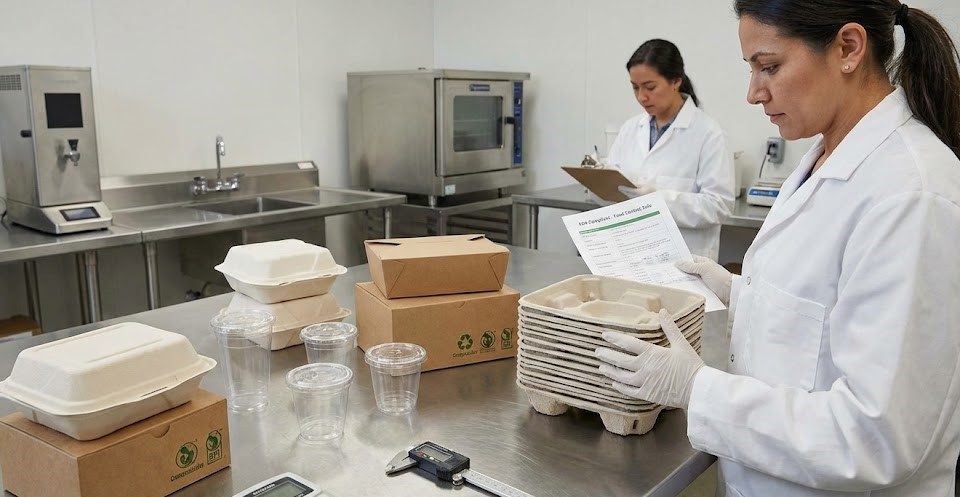
Migration testing evaluates whether substances from packaging transfer into food under real-world conditions. This testing simulates exposure to different food types, temperatures, and contact durations.
Only materials that demonstrate acceptable migration limits are considered compliant for food contact.
Temperature and Use Conditions
FDA compliance is tied to intended use. Packaging approved for cold foods may not be safe for hot foods or microwave use.
Suppliers should clearly define:
- Maximum temperature limits
- Hot-fill or reheating suitability
- Freezer or cold-storage compatibility
Using packaging outside its approved temperature range can invalidate compliance.
Additives, Coatings, and Inks
Inks, adhesives, coatings, and barrier layers are regulated separately from base materials. Even if a fiber tray or paperboard container is compliant, non-approved inks or coatings can compromise food safety.
Sustainable packaging should use FDA-compliant, low-migration inks and water-based or approved coatings to maintain overall compliance.
Why FDA Compliance Matters to Businesses
Failure to comply with FDA food-contact regulations exposes businesses to serious risks. Non-compliant packaging can lead to product recalls, regulatory action, legal liability, and long-term brand damage.
Conversely, clear FDA compliance provides a strong competitive advantage. Institutional buyers such as hospitals, universities, government facilities, and large QSR chains often require documented food-safety compliance as part of their procurement standards.
By showcasing FDA-compliant packaging, businesses demonstrate that sustainability and safety go hand in hand, building trust with both regulators and customers.
Managing Compliance in a Changing Supply Chain
Sustainable packaging formulations evolve frequently as suppliers improve materials or reduce environmental impact. Each change, even minor adjustments to coatings or additives, can affect compliance status.
Best practices include:
- Reviewing compliance documentation annually
- Revalidating materials when formulations change
- Maintaining traceable records from suppliers
- Aligning procurement, quality, and sustainability teams
Proactive compliance management reduces risk and ensures continuity across product lines and regions.
Global Context for Brands Operating Internationally
For companies exporting products or operating across borders, FDA compliance alone may not be sufficient. Other jurisdictions have their own food-contact regulations.
Key international standards include:
- EU Regulation 1935/2004 for materials intended to come into contact with food
- Canadian Food Inspection Agency (CFIA) guidelines
Many multinational brands harmonize packaging specifications to meet FDA, EU, and Canadian requirements simultaneously. This approach simplifies sourcing, reduces duplication, and supports global scalability.
The Role of Transparency and Documentation
Transparency is increasingly important in both regulatory and sustainability conversations. Brands that clearly communicate food-safety compliance strengthen credibility and reduce the risk of greenwashing claims.
Clear documentation, supplier guarantees, and test reports support responsible marketing and informed decision-making across the supply chain.
Ready to Verify Your Packaging for FDA Compliance?
Ensuring sustainable packaging meets FDA food-contact regulations requires the right materials, documentation, and supplier alignment. Our team helps businesses evaluate packaging, verify compliance, and select food-safe sustainable solutions that meet regulatory and operational requirements. Connect with our team or book a call to review your packaging and ensure it is both safe and sustainable.
FAQs
Q1: Do compostable materials require FDA approval?
Yes. All packaging that comes into contact with food must comply with FDA food-contact regulations, regardless of sustainability claims.
Q2: Is recycled paperboard automatically food-safe?
No. Recycled paperboard must use verified virgin liners or certified post-consumer fiber approved for food contact.
Q3: What documents should buyers request from suppliers?
Letters of Guarantee and migration test reports from accredited laboratories.
Q4: How often should FDA compliance be reviewed?
At least annually, or whenever material formulations or suppliers change.
