
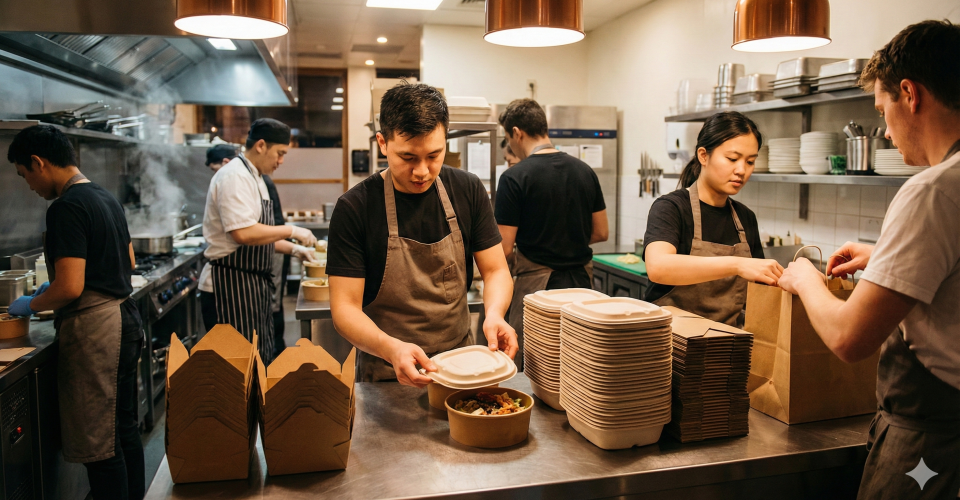
New hires. Busy shifts. Rising order volume.
Yet guests still expect speed, accuracy, and consistency, every single time.
By late 2025, hospitality operators are facing a new reality. Staffing cycles are shorter, onboarding is more frequent, and delivery and takeout orders now move side-by-side with dine-in service. In this environment, operational complexity doesn’t just slow teams down, it directly impacts guest experience.
One of the most underestimated drivers of errors and inefficiency? Packaging.
The Hidden Cost of Complex Packaging Systems
Packaging is often treated as a procurement or branding decision. But on the floor, it becomes a training and execution issue.
When staff are juggling:
- Multiple container sizes
- Non-standard lids
- Similar-looking bowls with different portions
- Inconsistent takeout setups
Mistakes increase—especially during peak hours and with newer team members.
Each additional decision a staff member must make adds friction. And friction is the enemy of speed, accuracy, and confidence.
Why Simpler Packaging Leads to Better Training Outcomes
New hires don’t struggle because they’re unmotivated. They struggle because systems are unclear.
Simplified packaging creates:
- Faster learning curves
- Fewer questions during rush hours
- Less reliance on senior staff
- Greater confidence on the line
When the system is intuitive, training becomes reinforcement, not constant correction.
1. Reduce the Number of Container Types at Prep Stations
Prep stations should support speed, not decision-making.
Limiting each station to only the containers needed for that menu section reduces hesitation and errors. Staff don’t need to pause, compare, or second-guess. They reach, grab, and move on.
Operational benefits include:
- Faster order assembly
- Cleaner, less cluttered stations
- Lower risk of wrong packaging during peak service
2. Standardize Lids and Bases Across Menu Items
Few things slow service more than searching for the right lid.
Standardizing lids and bases across multiple menu items eliminates a common bottleneck. It also simplifies storage, reordering, and inventory control.
For new hires, this removes unnecessary complexity. For experienced staff, it reduces frustration and keeps momentum during busy shifts.
3. Use Clearly Sized Bowls and Trays to Prevent Portion Errors
Containers should communicate their purpose instantly.
Clearly differentiated sizes, visually and physically, act as built-in portion control. Staff don’t need to memorize measurements or rely on guesswork.
This leads to:
- Consistent portioning
- Reduced food waste
- Fewer remakes
- Higher guest satisfaction
When packaging supports accuracy, quality becomes repeatable.
4. Pre-Build Packaging Kits for Takeout and Delivery
Takeout and delivery are no longer optional add-ons, they are core to modern hospitality revenue.
Pre-built packaging kits streamline fulfillment by grouping everything needed for an order:
- Containers and lids
- Cutlery and napkins
- Seals or labels
These kits reduce missed items, speed up order flow, and make it easier for new staff to execute confidently without constant oversight.
Packaging as an Operational Strategy, Not Just a Supply Choice
In high-pressure hospitality environments, consistency doesn’t come from asking teams to work harder. It comes from designing systems that work when things get busy.
Simplified packaging:
- Reduces training time
- Minimizes errors under pressure
- Improves team efficiency
- Protects brand standards across every order
The operators who succeed in 2025 and beyond will be the ones who remove friction before it becomes a problem.
Ready to Simplify Your Packaging and Strengthen Operations?
If your team is onboarding faster, serving more orders, or struggling with consistency during peak hours, it may be time to rethink your packaging system.
Explore smarter packaging solutions designed for speed, accuracy, and scalability.
Connect with our team to see how we can help you simplify operations and support your team where it matters most.
