
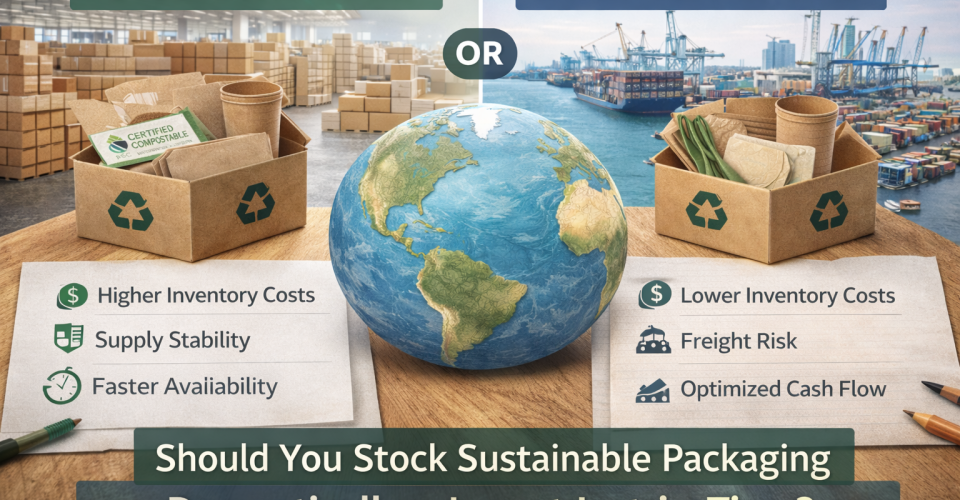
For brands investing in sustainable packaging, sourcing decisions don’t end at material selection. A critical operational question follows:
Should you stock sustainable packaging domestically, or import it just-in-time (JIT)?
In 2026, this decision impacts far more than warehouse space. It affects cash flow, ESG reporting, carbon footprint, supply chain resilience, regulatory risk, and customer satisfaction.
Both strategies can support sustainable growth, but only when aligned with your demand patterns, risk tolerance, and sustainability goals. This guide breaks down the trade-offs and helps you determine which model or hybrid approach makes the most sense.
What Does “Stock Domestically” vs “Import Just-in-Time” Mean?
- Stocking domestically means holding sustainable packaging inventory in local warehouses (either owned or third-party), ready for immediate distribution.
- Importing just-in-time means placing overseas production orders timed to arrive shortly before packaging is needed, minimizing local inventory holding.
Each model affects cost structure, emissions, and operational stability differently.
Why This Decision Is More Complex in 2026
Sustainable packaging introduces additional variables:
- Compostable materials may have limited shelf-life considerations
- Certification documentation must stay current
- Scope 3 emissions reporting includes freight
- ESG scrutiny requires traceability and audit readiness
- Freight volatility remains unpredictable
The wrong inventory strategy can undermine both sustainability and operational efficiency.
The Case for Stocking Sustainable Packaging Domestically
1. Greater Supply Stability
Domestic stock reduces exposure to:
- Port congestion
- Customs delays
- Ocean freight disruptions
- Geopolitical volatility
For fast-moving SKUs or enterprise contracts, supply continuity often outweighs carrying costs.
2. Faster Response to Demand Fluctuations
Restaurants, retailers, and CPG brands face unpredictable volume shifts. Local inventory enables:
- Rapid replenishment
- Flexible distribution
- Reduced stockout risk
Stockouts in sustainable packaging can force emergency substitutions, sometimes with less sustainable materials.
3. Improved Customer and Procurement Confidence
Enterprise buyers increasingly value:
- Reliable lead times
- Clear documentation access
- Stable product specifications
Domestic inventory supports smoother audits and predictable service levels.
4. Reduced Emergency Freight Emissions
Ironically, JIT models sometimes increase carbon footprint when delays require air freight. Local inventory minimizes last-minute, high-emission shipping solutions.
The Case for Importing Sustainable Packaging Just-in-Time
1. Lower Inventory Carrying Costs
Warehousing involves:
- Storage fees
- Insurance
- Obsolescence risk
- Tied-up working capital
JIT reduces capital locked in packaging inventory, particularly important for growing brands.
2. Reduced Risk of Specification Changes
Sustainability standards evolve quickly. Holding large domestic stock may create:
- Outdated certification documentation
- Branding updates
- Regulatory non-compliance
JIT sourcing allows more flexibility to adjust specifications.
3. Optimized Cash Flow
For scaling companies, liquidity often matters more than minor lead time advantages. JIT aligns purchasing closer to revenue generation.
4. Lower Waste Risk for Compostable Materials
Some compostable or bio-based packaging can degrade under improper storage conditions. Smaller, timed shipments reduce long-term storage exposure.
The Carbon Impact Question
One of the biggest misconceptions is assuming JIT always lowers environmental impact.
Consider:
- Ocean freight is efficient per unit but long-distance
- Warehousing consumes energy
- Emergency air freight dramatically increases emissions
- Overproduction due to safety stock increases waste
The more sustainable model depends on:
- Demand predictability
- Freight reliability
- Inventory turnover speed
Sustainability is about system efficiency, not just proximity.
The Financial Reality: Total Cost of Ownership (TCO)
Unit price alone is misleading. Evaluate:
- Freight variability
- Warehouse overhead
- Risk mitigation costs
- Inventory write-offs
- Compliance penalties
- Stockout-related revenue loss
Often, a slightly higher per-unit cost combined with stable domestic stock results in lower overall risk and total cost.
The Hybrid Model: Increasingly Common in 2026
Many brands now combine both strategies.
Example hybrid approaches:
- Core SKUs stocked domestically
- Specialty or seasonal packaging imported JIT
- Safety stock maintained regionally
- Dual-sourcing integrated with inventory buffers
This balanced strategy supports resilience without excessive capital commitment.
Key Questions to Guide Your Decision
Ask:
- How predictable is our packaging demand?
- What is our tolerance for stockouts?
- Are we prepared for freight disruptions?
- How do storage conditions affect compostable materials?
- How does inventory strategy affect ESG reporting?
The right choice depends on growth stage, industry volatility, and sustainability priorities.
So, Which Is Smarter?
There is no universal answer.
- Domestic stocking prioritizes stability and responsiveness.
- Just-in-time importing prioritizes liquidity and lean operations.
- Hybrid strategies increasingly offer the best balance.
In 2026, the smartest model is the one aligned with your demand profile, carbon accounting framework, and risk management strategy.
If you’re evaluating whether to stock sustainable packaging domestically or import just-in-time, Direct Source Procurement can help you assess risk, cost, carbon impact, and supply continuity before making a strategic shift.
Book a free consultation to design an inventory and sourcing strategy aligned with your sustainability and growth goals.
FAQs
1. Is just-in-time always more cost-effective?
Not necessarily. Lower inventory costs can be offset by freight volatility and disruption risks.
2. Does domestic stocking reduce carbon footprint?
It can reduce emergency freight emissions, but total impact depends on turnover and warehouse efficiency.
3. What’s the biggest risk of JIT importing?
Supply chain disruptions leading to stockouts or costly expedited shipping.
4. Can compostable packaging be stored long-term?
Some materials are sensitive to humidity and temperature. Proper storage conditions are essential.
5. Is a hybrid model more complex to manage?
Yes, but it often provides the best balance between resilience, sustainability, and financial efficiency.