
As sustainability expectations rise and supply chains remain under scrutiny, procurement leaders are reevaluating one critical question:
Is nearshoring or overseas sourcing smarter for sustainable packaging in 2026?
The answer is no longer driven by cost alone. Today’s decision must factor in ESG reporting, traceability, carbon impact, regulatory risk, lead time stability, and total cost of ownership.
Both models can support sustainable packaging programs, but only when aligned with your operational realities and growth strategy.
This guide breaks down the trade-offs and helps brands choose the sourcing model that makes sense for their 2026 sustainability goals.
What Do Nearshoring and Overseas Sourcing Mean?
Nearshoring refers to sourcing packaging from suppliers geographically closer to your primary market (e.g., North America to Mexico or domestic U.S. manufacturing).
Overseas sourcing typically involves suppliers in distant markets such as Asia or Eastern Europe.
Both approaches can produce recyclable, compostable, or certified sustainable packaging. The difference lies in logistics, risk exposure, and supply chain transparency.
The 2026 Context: Why This Decision Is More Complex Now
Several factors make the nearshore vs overseas debate more nuanced in 2026:
- Stricter sustainability reporting requirements
- Heightened scrutiny of environmental claims
- Increased focus on Scope 3 emissions
- Continued geopolitical and freight volatility
- Stronger traceability expectations from B2B buyers
Sourcing decisions now affect more than operations, they impact brand credibility and regulatory compliance.
The Case for Nearshoring Sustainable Packaging
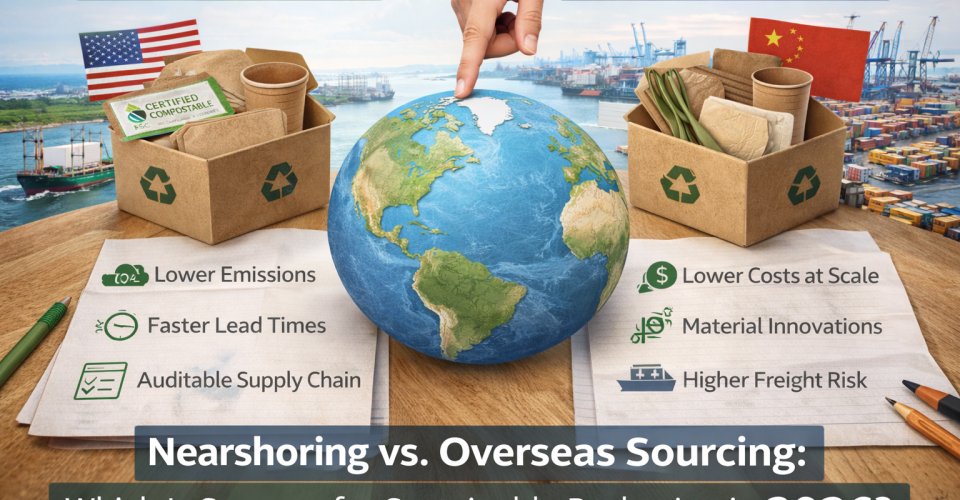
1. Reduced Transportation Emissions
Shorter shipping distances can reduce freight-related carbon emissions, which supports Scope 3 reporting improvements.
For brands prioritizing carbon reduction targets, nearshoring offers measurable environmental benefits.
2. Faster Lead Times and Greater Flexibility
Nearshore suppliers often provide:
- Shorter production cycles
- Faster replenishment
- Greater agility during demand shifts
This reduces excess inventory and waste, an often overlooked sustainability factor.
3. Improved Supply Chain Transparency
Closer geographic proximity often enables:
- Easier facility audits
- Clearer supplier communication
- More frequent quality checks
For brands emphasizing traceable packaging sources, nearshoring can simplify oversight.
4. Lower Disruption Risk
While no supply chain is immune to disruption, nearshoring reduces exposure to:
- Port congestion
- Cross-ocean freight delays
- Long transit variability
For fast-growing brands, this stability can outweigh marginal cost differences.
The Case for Overseas Sourcing Sustainable Packaging
1. Cost Efficiency at Scale
Overseas suppliers often benefit from:
- Larger production capacities
- Established material supply networks
- Economies of scale
For high-volume programs, overseas sourcing may still deliver lower per-unit costs.
2. Advanced Material Innovation
Certain global regions specialize in:
- Compostable biopolymers
- Molded fiber advancements
- Specialized coatings
In some cases, overseas partners offer broader material options for sustainable packaging innovation.
3. Mature Sustainable Manufacturing Ecosystems
Contrary to outdated assumptions, many overseas facilities operate under:
- International certifications
- Advanced quality control systems
- Strong environmental management practices
However, transparency and verification remain essential.
The Hidden Factor: Total Cost of Ownership
The smarter decision in 2026 often depends on total cost of ownership (TCO) rather than unit price.
TCO considerations include:
- Freight and fuel costs
- Inventory carrying costs
- Risk of delays and stockouts
- Compliance and documentation burden
- Carbon accounting implications
A lower overseas unit price may be offset by higher freight volatility or inventory requirements. Conversely, nearshoring may carry slightly higher base pricing but reduce systemic risk.
Sustainability Is About Systems, Not Geography
One of the biggest misconceptions in sustainable packaging sourcing is that “local equals sustainable” and “overseas equals unsustainable.”
Sustainability depends on:
- Material selection
- Manufacturing efficiency
- Certifications and documentation
- Waste and emissions management
- Supply chain transparency
A poorly managed nearshore supplier can undermine sustainability goals just as easily as an opaque overseas one.
Hybrid Models: The Growing 2026 Strategy
Many brands are no longer choosing one over the other. Instead, they’re adopting hybrid sourcing models.
This approach may include:
- Nearshore suppliers for high-turn SKUs
- Overseas partners for specialty materials
- Dual-sourcing for redundancy
- Regional flexibility based on infrastructure
Hybrid models balance cost efficiency with resilience and ESG goals.
Key Questions to Guide Your Decision
When evaluating nearshoring vs overseas sourcing for sustainable packaging, ask:
- What are our Scope 3 emissions targets?
- How critical is lead time flexibility?
- Do we need frequent audits or site visits?
- What is our risk tolerance for freight volatility?
- Can we validate sustainability claims across regions?
The right answer depends on your growth stage, regulatory exposure, and operational complexity.
Which Is Smarter in 2026?
There is no universal winner.
- Nearshoring often makes sense for brands prioritizing agility, carbon reduction, and transparency.
- Overseas sourcing may remain optimal for cost-driven, high-volume, or specialty-material programs.
- Hybrid strategies increasingly offer the most balanced path.
In 2026, the smartest sourcing decision is the one that aligns sustainability commitments with operational reality.
If you’re evaluating nearshoring vs overseas sourcing for sustainable packaging, Direct Source Procurement can help you assess total cost, carbon impact, risk exposure, and supplier transparency before making a commitment.
Book a free consultation to explore sourcing strategies tailored to your sustainability and growth goals.
FAQs
1. Is nearshoring always more sustainable than overseas sourcing?
Not necessarily. Sustainability depends on materials, manufacturing practices, and transport efficiency, not geography alone.
2. Does overseas sourcing automatically increase carbon footprint?
Longer transportation distances can increase emissions, but manufacturing efficiency and freight consolidation can offset some impact.
3. What is a hybrid sourcing model?
A strategy that combines nearshore and overseas suppliers to balance cost, resilience, and sustainability goals.
4. How does sourcing affect ESG reporting?
Supplier location and freight emissions contribute to Scope 3 calculations and traceability disclosures.
5. Should growing brands prioritize cost or stability?
In many cases, stability and transparency reduce long-term risk and total cost more effectively than focusing on unit price alone.
