As sustainability commitments grow, more brands are switching to compostable packaging. But one of the most common mistakes companies make is assuming that a “compostable” label guarantees acceptance everywhere. In reality, composting standards vary widely by region, facility type, and material composition.
Ensuring your packaging meets local composting standards is essential not only for environmental integrity, but also for operational efficiency, regulatory compliance, and brand credibility. When packaging aligns with regional infrastructure, it protects your sustainability goals and prevents costly contamination or greenwashing risks.
Why Composting Compliance Is More Complex Than It Seems
Composting is not a single, universal system. Across North America and globally, composting facilities operate with different technologies, temperature ranges, processing times, and material tolerances. Some facilities accept only fiber-based packaging, while others can process certain bioplastics such as PLA or PHA.
This variation means that a product certified as compostable under industrial conditions may still be rejected locally if it does not match a facility’s capabilities. For brands operating across multiple regions, this complexity can quickly scale into a compliance challenge.
Understanding how local composting systems work is the first step toward ensuring your packaging actually achieves its intended environmental outcome.
Understanding Regional and Municipal Variations
Local composting acceptance is shaped by infrastructure, not intent. Municipal programs, private haulers, and commercial composters each set their own rules based on equipment, contamination thresholds, and processing capacity.
For example:
- Some regions accept only fiber-based materials such as bagasse, molded fiber, and paperboard.
- Others allow PLA or PHA items, but only in specific formats like thin films or cold cups.
- Certain facilities exclude compostable plastics entirely due to sorting challenges or processing timelines.
Before scaling a packaging change, brands should consult:
- Municipal waste management departments
- Commercial composting facilities
- Waste haulers servicing their locations
Documenting this acceptance upfront avoids mismatches between packaging claims and real-world disposal options.
Certification as a Baseline, Not the Finish Line
Third-party certifications play a critical role in validating compostability, but they should be treated as a starting point rather than a final guarantee.
Recognized certifications include:
- BPI (Biodegradable Products Institute) for North America
- TÜV Austria Industrial Compostable
- EN 13432 for European markets
These certifications confirm that materials break down under industrial composting conditions within a defined timeframe and do not leave harmful residues or microplastics. However, certification does not override local acceptance rules.
Best practice is to pair certification with local confirmation. Facilities may request product spec sheets, resin details, or prior testing data before approving new materials.
Designing Packaging for Real-World Composting
Compliance is not only about materials, but also about design choices. Thickness, coatings, inks, and additives all influence whether packaging successfully composts.
To improve acceptance:
- Avoid excessive thickness that slows breakdown
- Use water-based or soy-based inks
- Minimize coatings or ensure they are compostable
- Keep material composition simple and clearly documented
Clear labeling such as “Commercially Compostable Where Accepted” helps set correct expectations while protecting brands from misleading claims.
Training Staff and Guiding End Users
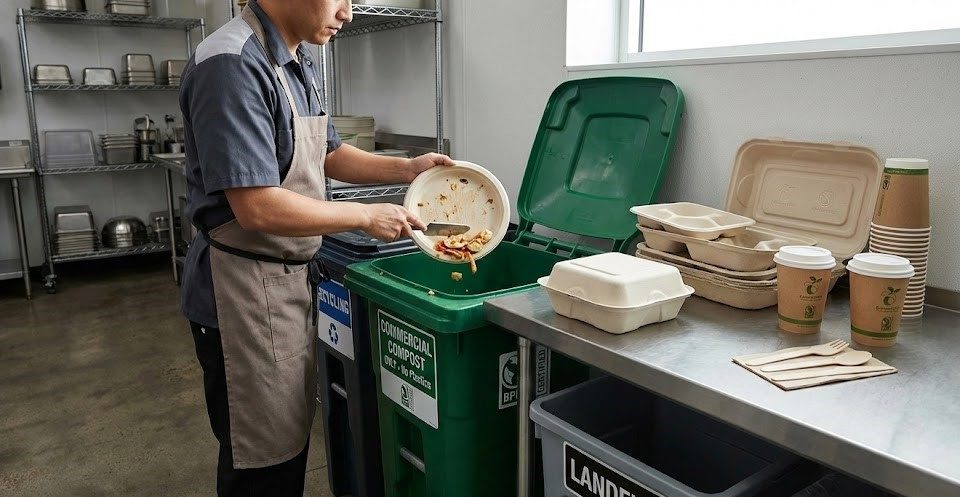
Even the most compliant packaging fails if it is disposed of incorrectly. Contamination is one of the biggest challenges composting facilities face, and it often starts at the point of disposal.
Effective strategies include:
- Clear bin labeling with icons and short instructions
- Consistent color coding across locations
- Simple visual signage showing what goes where
- Staff training during onboarding and refresh cycles
When employees and customers understand disposal rules, compostable packaging actually reaches the right waste stream, protecting the entire system.
Partnering Directly With Composting Facilities
One of the most effective yet underused strategies is building direct relationships with local composters. These partners offer valuable insight into what materials process best and which designs create challenges.
Composting partners can:
- Validate packaging choices before rollout
- Share contamination feedback
- Provide waste diversion data
- Support co-branded sustainability reporting
For brands with public sustainability commitments, these partnerships also strengthen transparency and credibility.
The Business Payoff of Getting It Right
When packaging aligns with local composting standards, the benefits extend beyond environmental impact.
Brands see:
- Cleaner waste streams
- Lower landfill hauling fees
- Reduced risk of compliance violations
- Stronger ESG and sustainability reporting
- Increased trust from customers and stakeholders
Accurate composting compliance positions a brand as genuinely responsible, rather than performative. In a market where sustainability claims are increasingly scrutinized, precision matters.
Ready to Align Your Packaging With Local Composting Rules?
Navigating composting standards can be complex, especially across multiple regions. Our team helps brands evaluate materials, verify local acceptance, and implement compostable packaging strategies that actually work in real-world systems. Connect with our team or book a call to ensure your packaging meets local composting standards without risking contamination or credibility.
FAQs
Q1: Is all compostable packaging accepted everywhere?
No. Acceptance depends on local composting infrastructure and facility capabilities.
Q2: How can brands verify acceptance?
By contacting municipal waste programs, regional haulers, or local composting facilities directly.
Q3: What’s the risk of non-compliance?
Higher waste costs, rejected materials, and potential greenwashing or regulatory claims.
Q4: Should packaging display compost logos?
Yes. Clear certification marks and disposal instructions improve sorting accuracy and trust.
