
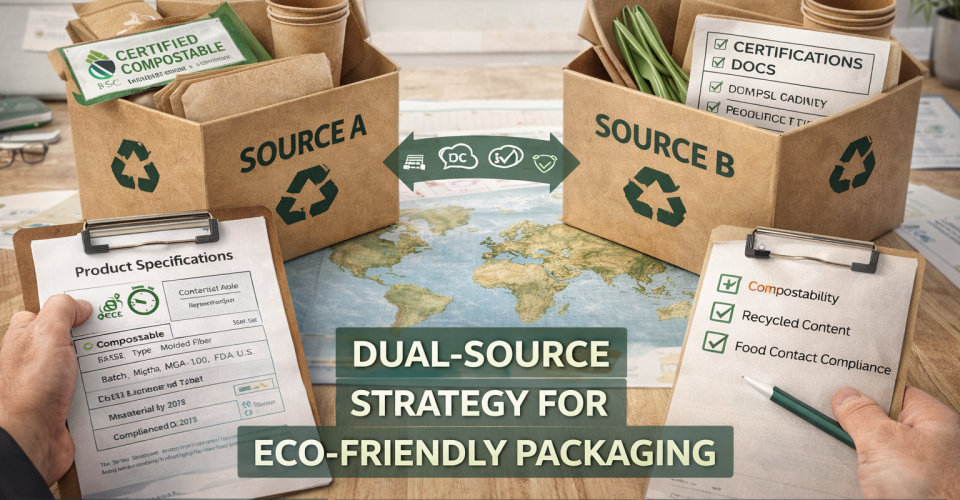
Sustainable packaging is no longer a niche initiative, it’s a core operational priority. But as brands shift toward compostable, recyclable, or bio-based materials, they often introduce a new risk: overdependence on a single supplier.
In 2026, supply chain resilience is just as important as sustainability performance. That’s why more brands are building a dual-source strategy for eco-friendly packaging, a structured approach that balances sustainability goals with supply continuity, cost stability, and compliance confidence.
This guide explains how to design a dual-source model that reduces risk without compromising quality or environmental commitments.
What Is a Dual-Source Strategy in Sustainable Packaging?
A dual-source strategy means qualifying and maintaining at least two approved suppliers for the same packaging specification or functional equivalent.
For eco-friendly packaging, this includes:
- Compostable foodware
- Recyclable fiber packaging
- Molded pulp inserts
- Biopolymer films
- Certified sustainable paperboard
The goal isn’t to split orders randomly. It’s to create a risk-managed system where redundancy is intentional and performance remains consistent.
Why Dual-Sourcing Matters More for Eco-Friendly Materials
Eco-friendly packaging introduces additional complexity compared to conventional materials:
- Limited certified suppliers
- Evolving regulations
- Variable raw material availability
- Higher scrutiny around sustainability claims
If one supplier experiences shortages, certification lapses, or operational disruptions, brands without backup options face delays, reformulation risks, or compliance setbacks.
A dual-source strategy protects against these vulnerabilities.
Step 1: Standardize Specifications Before Adding a Second Source
Before onboarding a second supplier, your packaging specifications must be clearly defined and documented.
Critical details include:
- Material composition and percentages
- Coating or barrier type
- Thickness and structural tolerances
- Food-contact compliance conditions
- Certification requirements (e.g., compostability, FSC)
Without standardized specs, two suppliers may deliver products that appear similar but perform differently.
Consistency is the foundation of successful dual-sourcing.
Step 2: Verify Certifications and Documentation Across Both Suppliers
Eco-friendly packaging often relies on:
- Compostability certifications
- Recycled content verification
- Forest stewardship certifications
- Food-contact compliance documentation
Each supplier must provide independent documentation for the exact product supplied, not generic statements.
A dual-source strategy only reduces risk if both suppliers meet the same regulatory and sustainability standards.
Step 3: Test Functional Equivalency in Real Conditions
Even when specifications match on paper, real-world performance can vary.
Brands should test both sources under:
- Heat and moisture exposure
- Shipping and stacking conditions
- Operational handling environments
This ensures functional equivalency across:
- Structural integrity
- Barrier performance
- Print and branding consistency
Testing early prevents operational surprises later.
Step 4: Balance Geographic Risk
Dual-sourcing doesn’t require both suppliers to be in the same region.
Many brands use:
- One nearshore supplier for agility
- One overseas supplier for cost efficiency
This geographic diversification helps mitigate:
- Freight disruptions
- Regional regulatory changes
- Political instability
However, sustainability claims must remain consistent regardless of origin.
Step 5: Establish Clear Allocation and Contingency Rules
A dual-source strategy works best when roles are defined.
Common models include:
- Primary supplier (70–80%) and secondary supplier (20–30%)
- Regional split allocation
- Backup-only activation model
Contingency triggers should be pre-defined, such as:
- Lead time increases
- Cost volatility
- Certification changes
Clear rules prevent reactive decision-making during disruptions.
Step 6: Align Dual-Sourcing With ESG and Reporting Goals
Procurement decisions now influence ESG reporting and Scope 3 emissions calculations.
When building a dual-source strategy, evaluate:
- Carbon footprint differences between suppliers
- Transportation emissions
- Manufacturing energy sources
- Transparency and traceability practices
Dual-sourcing should strengthen sustainability reporting, not complicate it.
Step 7: Maintain Ongoing Performance Reviews
Dual-sourcing is not a one-time setup. Both suppliers must be continuously monitored for:
- Quality consistency
- Documentation updates
- Certification renewals
- Cost fluctuations
- Service reliability
Regular performance audits ensure the strategy remains effective over time.
Common Mistakes to Avoid
- Adding a second supplier without clear specs
- Assuming certifications transfer across facilities
- Ignoring food-contact compliance differences
- Overcomplicating SKUs beyond manageable levels
- Treating the secondary supplier as inactive until a crisis
A dormant backup supplier may not be ready when needed.
The Strategic Advantage of Dual-Sourcing in 2026
In today’s environment, sustainable packaging programs must balance:
- Environmental responsibility
- Supply chain resilience
- Regulatory compliance
- Cost control
A well-designed dual-source strategy creates operational confidence. It allows brands to scale sustainably while protecting against volatility.
Dual-sourcing is no longer just a procurement tactic, it’s a risk management and sustainability alignment strategy.
If you’re evaluating eco-friendly packaging suppliers and want to build a dual-source strategy that strengthens both resilience and sustainability, Direct Source Procurement can help you standardize specifications, validate suppliers, and reduce sourcing risk at scale.
Book a free consultation to assess your packaging supply chain and build a smarter dual-source model.
FAQs
1. What is the main benefit of a dual-source strategy?
It reduces supply chain risk by preventing overdependence on a single supplier.
2. Does dual-sourcing increase costs?
Not necessarily. While administrative effort may increase, it often lowers long-term risk and disruption costs.
3. Should both suppliers be in the same region?
Not always. Geographic diversification can further reduce risk.
4. How do certifications factor into dual-sourcing?
Each supplier must independently provide valid certifications for the exact materials supplied.
5. Is dual-sourcing necessary for all eco-friendly packaging?
It depends on volume, growth stage, and risk tolerance, but for many growing brands, it significantly improves resilience.
