
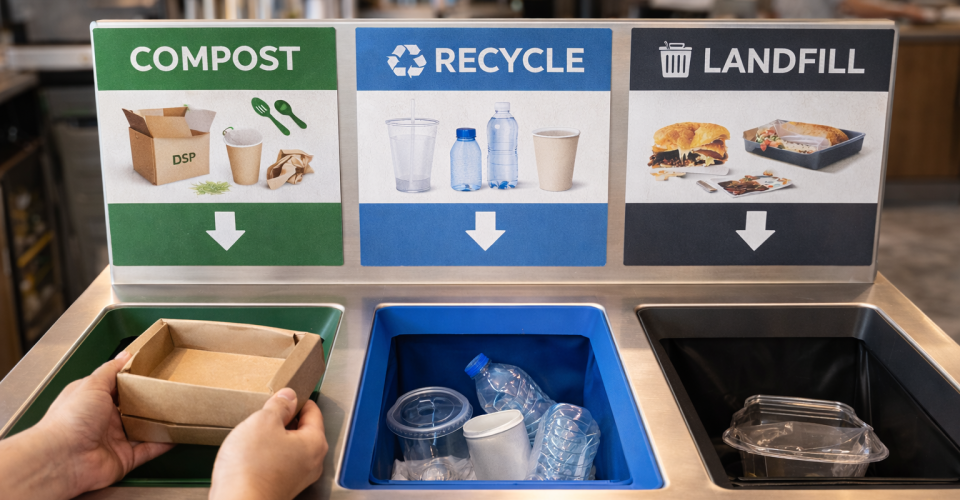
For many restaurants, sustainable foodware decisions stop at material selection. Compostable cups, fiber bowls, or recyclable containers are chosen with good intentions, but what happens after the food is consumed is often left to chance.
In reality, sustainability outcomes depend far more on post-use pathways than on material claims alone. If foodware isn’t disposed of correctly, or can’t be processed by available systems, it won’t deliver the environmental benefits brands expect.
Closing the loop in foodware requires moving beyond theory and designing post-use systems that actually work in real restaurant environments. This means aligning materials, operations, staff behavior, customer behavior, and local infrastructure.
What Does “Closing the Loop” Mean in Foodware?
Closing the loop refers to designing foodware systems where materials are:
- Used as intended
- Collected correctly after use
- Processed through viable recycling or composting systems
- Returned to productive use rather than landfill
For restaurants, this isn’t a packaging-only problem, it’s an operational systems challenge.
Why Post-Use Pathways Often Fail in Restaurants
Many sustainability programs fail not because of bad intentions, but because they ignore operational reality.
Common breakdown points include:
- Compostable foodware used where no composting infrastructure exists
- Poorly labeled waste streams that confuse customers and staff
- Mixed materials that contaminate recycling or compost bins
- Inconsistent practices across locations
If the disposal pathway isn’t clear, convenient, and reinforced, landfill becomes the default.
The Three Post-Use Pathways That Matter Most
For restaurants, nearly all foodware post-use scenarios fall into three categories.
1. Composting (When It’s Done Right)
Compostable foodware only works when all three conditions are met:
- Certified compostable materials
- Access to commercial composting facilities
- Clear separation of compostable waste from trash and recycling
What works in practice:
- Back-of-house composting for prep waste and dine-in service
- Front-of-house compost bins with clear visual cues
- Limiting compostables to items most likely to be captured correctly
What doesn’t:
- Compostable packaging in markets without compost access
- Overly complex compostable designs with coatings or labels that cause contamination
2. Recycling (Designed for Real-World Behavior)
Recycling remains a viable pathway, but only for materials that are widely accepted and easily identifiable.
Best practices include:
- Using mono-material designs (e.g., fiber-only without plastic linings)
- Avoiding black plastics or mixed substrates
- Clear on-pack disposal instructions
Restaurants should assume limited customer attention and design recycling pathways that work even when behavior isn’t perfect.
3. Reuse (Selective, Not Universal)
Reusable foodware can significantly reduce waste, but it only works in specific contexts.
Where reuse works best:
- Dine-in environments with controlled collection
- Closed-loop programs (e.g., campus, workplace, event venues)
- Deposit or incentive-based systems
Where it struggles:
- High-volume takeout without return infrastructure
- Locations with limited storage or washing capacity
Reuse should be treated as a strategic layer, not a one-size-fits-all solution.
Designing Foodware With the End in Mind
To close the loop, restaurants must design foodware choices backward from disposal, not forward from marketing claims.
Key design principles include:
1. Simplify Materials
Fewer materials mean fewer disposal mistakes. Foodware that looks and feels consistent is easier to sort correctly.
2. Align With Local Infrastructure
A compostable solution in one city may be landfill-bound in another. Regional flexibility is critical for multi-location brands.
3. Make the Right Choice the Easy Choice
Bins should be:
- Clearly labeled
- Color-coded
- Placed where waste is generated
The easier the system, the higher the compliance.
The Role of Staff and Customer Education
Education doesn’t need to be complex, but it must be consistent.
Effective strategies include:
- Simple bin signage with icons (not paragraphs)
- Staff training during onboarding
- Consistent packaging design across locations
- Short, clear disposal instructions printed on foodware
Education works best when reinforced by design and placement, not just messaging.
Measuring What Actually Works
Restaurants that successfully close the loop measure outcomes, not intentions.
Useful metrics include:
- Contamination rates in compost and recycling streams
- Volume of waste diverted from landfill
- Operational impact (labor time, storage needs)
- Cost implications over time
Small pilot programs can reveal what works before full rollout.
Closing the Loop Is an Operational Strategy
Sustainable foodware is no longer just a branding decision, it’s an operations and procurement strategy.
The most successful restaurant programs:
- Match materials to real disposal pathways
- Design for imperfect human behavior
- Standardize systems across locations
- Continuously refine based on data
Closing the loop isn’t about perfection, it’s about practical progress.
If you’re evaluating foodware options or struggling to make sustainability programs stick across locations, Direct Source Procurement can help you design post-use pathways that work in real restaurant environments.
Book a free foodware consultation to align materials, operations, and disposal systems at scale.
FAQs
1. Is compostable foodware always better than recyclable?
Not necessarily. Compostable foodware only delivers benefits when proper composting infrastructure exists and contamination is controlled.
2. How can restaurants reduce waste contamination?
Simplify materials, standardize bin signage, and train staff to reinforce correct disposal behaviors.
3. Does reusable foodware work for takeout?
It can, but only with return systems or closed-loop environments. Without infrastructure, reuse programs often fail.
4. How do multi-location restaurants handle different local systems?
By selecting flexible materials and adjusting disposal guidance based on regional infrastructure.
5. What’s the biggest mistake restaurants make with sustainable foodware?
Choosing materials based on claims alone, without planning for how they’ll be disposed of after use.
