
When procurement teams evaluate sustainable packaging, the conversation typically centers on material cost, certifications, and supplier pricing. But one of the most significant cost drivers often receives less attention:
Freight.
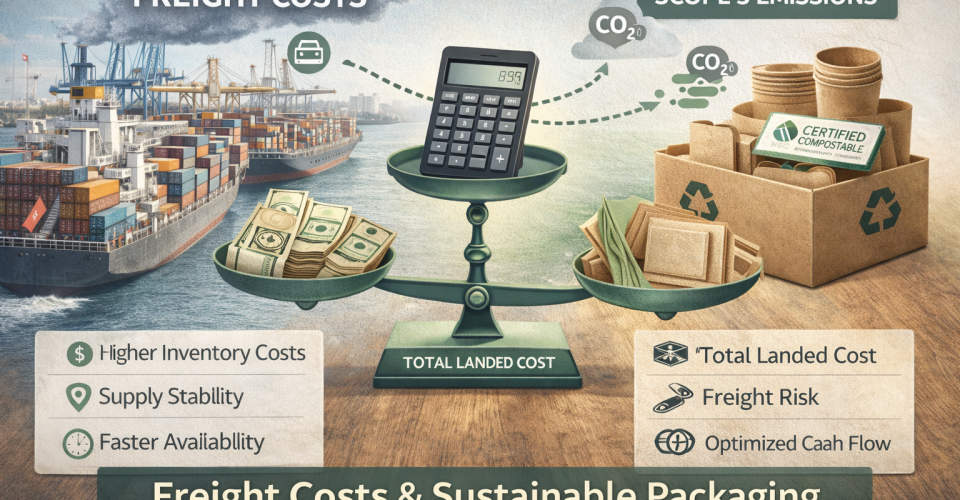
In 2026, freight costs and sustainable packaging are more tightly connected than ever. Ocean volatility, fuel price fluctuations, carbon reporting requirements, and dimensional shipping constraints mean that packaging design directly influences logistics performance.
Sustainable packaging is not just a material decision, it’s a freight strategy decision. And overlooking this connection can quietly erode margins.
Why Freight Is a Hidden Variable in Sustainable Packaging
Freight costs are typically evaluated after packaging decisions are made. But packaging influences:
- Dimensional weight
- Pallet density
- Container utilization
- Mode of transport
- Carbon emissions reporting
Even minor design changes, such as slightly thicker walls or nested configurations can significantly impact shipping economics.
When freight isn’t factored into early packaging decisions, total landed cost calculations become incomplete.
The Dimensional Weight Factor
In modern freight pricing, especially air and parcel shipping, dimensional weight (DIM weight) often determines cost—not actual weight.
Sustainable packaging sometimes increases dimensions due to:
- Thicker molded fiber structures
- Reinforced compostable materials
- Extra protective layering
If packaging takes up more space, even while remaining lightweight, freight costs may increase disproportionately.
Procurement teams must evaluate packaging specifications alongside shipping configurations, not in isolation.
Container Utilization and Pallet Efficiency
Sustainable packaging design affects how efficiently products fit into:
- Master cartons
- Pallets
- Shipping containers
Low-density packaging materials may reduce environmental impact per unit but if they decrease pallet efficiency by 10–15%, overall logistics costs and emissions may rise.
For high-volume programs, improved container utilization often offsets material cost differences.
Smart procurement teams ask:
- How many units fit per pallet?
- What is the cube efficiency per container?
- Does this material increase void space?
Small improvements here generate measurable savings.
The Freight Emissions Trade-Off
Sustainability commitments now include Scope 3 emissions, freight included.
Consider this scenario:
- A compostable packaging option reduces material emissions by 8%.
- But lower container density increases shipping frequency by 12%.
The net environmental benefit may shrink or reverse.
True sustainability analysis requires evaluating:
- Material carbon footprint
- Freight carbon footprint
- Total lifecycle impact
Freight efficiency is an environmental variable, not just a financial one.
Mode of Transport Matters
Procurement decisions often influence transport mode.
For example:
- Just-in-time overseas sourcing increases exposure to air freight during delays.
- Domestic stocking reduces emergency shipping risks.
- Nearshoring can reduce transit times and volatility.
Sustainable packaging sourcing models must align with predictable shipping methods. Emergency freight often carries both higher cost and significantly higher emissions.
The Inventory-Freight Balance
Inventory strategy directly impacts freight exposure.
Import just-in-time models:
- Reduce inventory carrying costs
- Increase freight risk sensitivity
Domestic stocking:
- Increases storage costs
- Reduces urgent shipping dependence
When evaluating sustainable packaging, procurement teams should integrate:
- Inventory turnover
- Safety stock levels
- Freight variability trends
Freight risk and inventory risk are interconnected.
Packaging Design as a Freight Strategy Tool
Forward-thinking brands treat packaging engineering as a logistics lever.
Freight-optimized sustainable packaging may include:
- Nestable designs
- Collapsible structures
- Optimized carton sizing
- Standardized dimensions across SKUs
- Reduced void space
These changes often improve both cost efficiency and carbon performance.
Sustainable design should enhance, not undermine logistics efficiency.
What Procurement Teams Often Overlook
- Total landed cost vs unit cost
Lower unit price doesn’t equal lower total cost if freight inefficiencies offset savings. - Freight volatility exposure
Packaging that requires longer transit routes increases exposure to disruptions. - Carbon accounting impact
Shipping frequency and distance significantly influence ESG reporting. - Specification creep
Small structural changes can unintentionally increase cubic volume. - Emergency freight contingency planning
Lack of redundancy often leads to high-cost last-minute shipping.
Freight costs and sustainable packaging must be evaluated together, not sequentially.
A Smarter Procurement Approach in 2026
In today’s environment, sustainable packaging decisions should include:
- Early freight modeling
- Container utilization simulations
- Carbon impact projections
- Dual-source considerations
- Inventory buffer alignment
Cross-functional collaboration between procurement, logistics, and sustainability teams reduces blind spots.
The most successful programs treat freight as part of packaging strategy, not an afterthought.
The Bottom Line
Sustainable packaging is only as effective as the system that supports it.
Freight costs and sustainable packaging decisions are interconnected. Ignoring that relationship can undermine both environmental goals and financial performance.
In 2026, the smartest procurement teams evaluate:
- Material efficiency
- Freight efficiency
- Carbon transparency
- Risk resilience
Together, not separately.
If you’re evaluating sustainable packaging options and want to understand the true freight and total landed cost implications, Direct Source Procurement can help you model logistics efficiency, reduce hidden costs, and align sourcing with ESG goals.
Book a free consultation to assess freight exposure and packaging performance before making your next sourcing decision.
FAQs
1. Does sustainable packaging increase freight costs?
It can, depending on dimensional weight, density, and container utilization.
2. How does freight affect ESG reporting?
Freight emissions contribute to Scope 3 calculations and overall carbon footprint disclosures.
3. What is dimensional weight?
Dimensional weight calculates shipping cost based on package volume rather than actual weight.
4. Can better packaging design reduce freight expenses?
Yes. Optimized nesting, standardized sizes, and higher pallet density can lower shipping costs.
5. Should procurement involve logistics teams in packaging decisions?
Absolutely. Cross-functional collaboration prevents cost and carbon blind spots.