As brands transition to sustainable packaging, food-contact safety has become one of the most misunderstood and most critical evaluation criteria. Compostable, recyclable, or bio-based materials may look environmentally responsible, but that doesn’t automatically make them safe for food contact.
For B2B buyers, restaurants, and consumer brands, the ability to read and interpret food-contact safety data is essential. Misunderstanding documentation can lead to compliance failures, product recalls, delayed launches, or reputational damage.
This guide breaks down how to read food-contact safety data for sustainable packaging, what to look for, what questions to ask, and how to avoid common pitfalls.
Why Food-Contact Safety Data Matters More in Sustainable Packaging
Sustainable packaging introduces new variables into food-contact safety evaluation:
- Novel materials and coatings
- Bio-based additives and inks
- Compostable barriers and adhesives
- Multi-layer fiber structures
Each of these elements can affect how substances migrate from packaging into food. Regulators don’t assess sustainability claims, they assess chemical safety and exposure risk.
That’s why food-contact safety data must be reviewed independently of environmental claims.
What Counts as Food-Contact Safety Data?
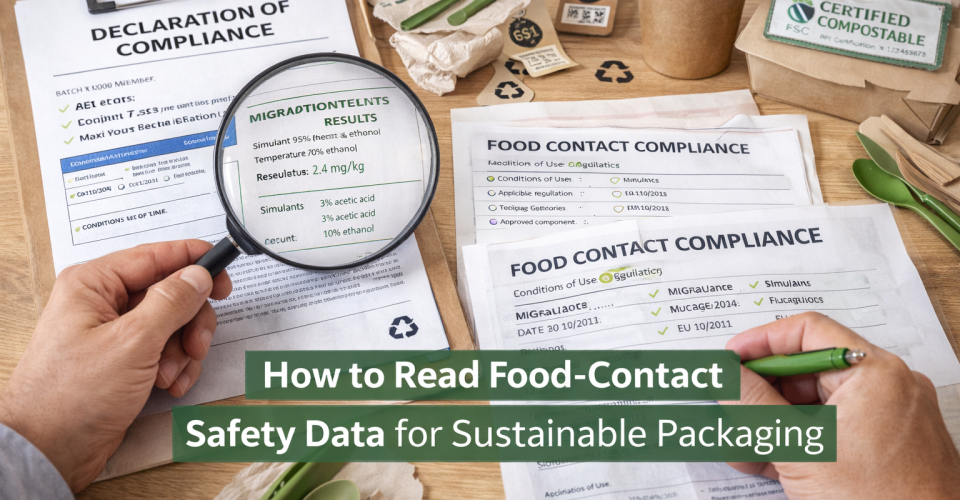
Food-contact safety data is not a single document. It’s a set of technical records that collectively demonstrate a material’s suitability for contact with food.
Common documents include:
- Declarations of Compliance (DoC)
- Food Contact Compliance Statements
- Migration test reports
- Regulatory references (FDA, EU, etc.)
- Supplier specifications and limitations
Each document serves a different purpose and none should be taken at face value without context.
Step 1: Identify the Applicable Regulatory Framework
Before reviewing any data, determine which regulations apply to your product and market.
Common frameworks include:
- FDA (U.S.) – 21 CFR regulations for food-contact materials
- EU Framework Regulation (EC) No 1935/2004
- EU Plastics Regulation (EU) No 10/2011 (often referenced even for non-plastics)
A compliant material in one region may not be compliant in another. Food-contact safety data must be market-specific.
Step 2: Read the Declaration of Compliance Carefully
A Declaration of Compliance is often the first document suppliers provide, but it’s also the most misunderstood.
When reviewing a DoC, check for:
- Exact material name and formulation
- Applicable regulation references
- Manufacturer and facility identification
- Date of issue and validity period
Red flag: Generic statements like “FDA compliant” without citing specific sections or conditions of use.
A credible DoC should clearly state what the material is compliant for and under what conditions.
Step 3: Understand Conditions of Use
Food-contact compliance is not universal. It depends on how the packaging is used.
Look for explicit limits on:
- Temperature (hot fill, microwave, oven use)
- Contact time (short-term vs. long-term storage)
- Food type (aqueous, acidic, fatty, alcoholic)
A material approved for dry foods at room temperature may not be safe for hot, greasy meals.
Sustainable packaging often fails here when coatings or additives behave differently under heat or moisture.
Step 4: Review Migration Testing Data
Migration testing evaluates whether substances transfer from packaging into food.
Key points to assess:
- Which simulants were used (oil, acid, alcohol, etc.)
- Testing temperatures and durations
- Overall migration limits (OML) and specific migration limits (SML)
- Lab accreditation and test date
Important: Migration testing must match your actual use case. If your product is hot and greasy, dry-food test results are irrelevant.
Step 5: Evaluate Inks, Coatings, and Additives Separately
One of the most common mistakes in sustainable packaging evaluation is assuming the base material approval covers everything.
You must assess:
- Printing inks
- Barrier coatings
- Adhesives
- Colorants and fillers
Each component can introduce new migration risks. Food-contact safety data should either:
- Cover the full finished structure, or
- Clearly document each component’s compliance
If documentation only covers the substrate, the evaluation is incomplete.
Step 6: Watch for Greenwashing in Safety Claims
Sustainability language can obscure safety gaps.
Be cautious of phrases like:
- “Plant-based, therefore safe”
- “Natural materials require no testing”
- “Compostable equals food-safe”
Regulators don’t evaluate intent, they evaluate evidence. Food-contact safety must be proven, not implied.
Step 7: Confirm Traceability and Version Control
Food-contact safety data must align with what you’re actually buying.
Confirm:
- Material batch consistency
- Supplier change controls
- Updated documentation for reformulations
Even small changes in fiber source, coating thickness, or additives can invalidate prior compliance data.
Why Procurement and Sustainability Teams Must Collaborate
Food-contact safety sits at the intersection of:
- Procurement
- Quality assurance
- Sustainability
- Legal and compliance
Siloed decision-making increases risk. The most successful brands review food-contact safety data before finalizing material choices, not after launch delays occur.
Reading Safety Data Is a Risk-Reduction Strategy
Understanding food-contact safety data helps brands:
- Avoid recalls and compliance violations
- Speed up approvals and audits
- Protect brand reputation
- Confidently scale sustainable packaging programs
In today’s regulatory environment, food-contact safety is not a checkbox, it’s a core sourcing competency.
If you’re evaluating sustainable packaging and want confidence that food-contact safety data truly supports your use case, Direct Source Procurement can help you review documentation, assess risk, and align materials with regulatory requirements.
Book a free consultation to evaluate food-contact safety data before it becomes a costly problem.
FAQs
1. Is compostable packaging automatically food-safe?
No. Compostability and food-contact safety are evaluated separately and require different documentation.
2. What’s the most common food-contact compliance mistake?
Relying on generic compliance statements without reviewing conditions of use or migration testing.
3. Do inks and coatings require separate food-contact approval?
Yes. Each component that contacts food must be evaluated for safety.
4. How often should food-contact safety data be updated?
Any time the formulation, supplier, or manufacturing process changes or when regulations are updated.
5. Who should review food-contact safety data internally?
Ideally a cross-functional team including procurement, quality, and compliance stakeholders.
