
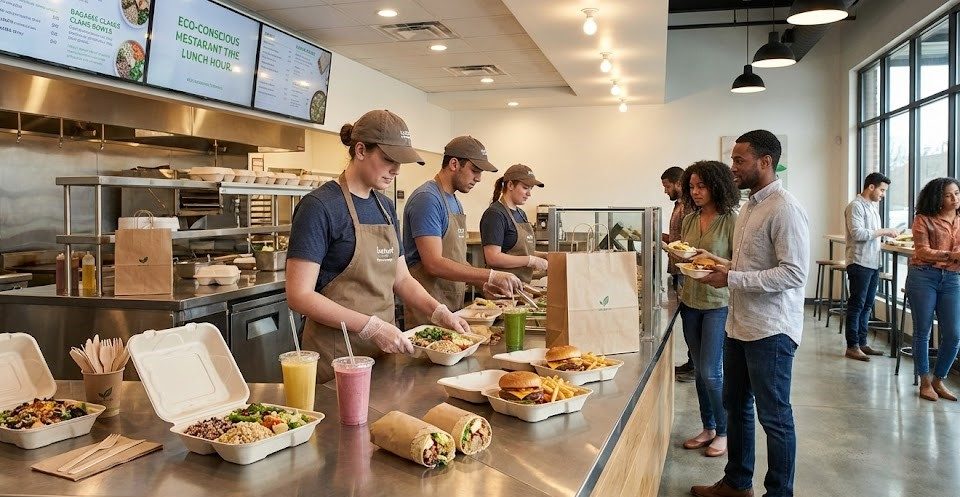
Quick-service restaurants (QSRs) thrive on speed, consistency, and cost control. But in an era where customers increasingly expect eco-conscious practices, packaging has become more than just a container, it’s a reflection of brand values.
The challenge for most QSRs is finding sustainable packaging options that maintain operational efficiency while minimizing environmental impact. Fortunately, new materials and designs now offer both: functionality that fits fast-paced service and eco benefits that resonate with modern diners.
Here are ten of the most practical and effective sustainable packaging ideas every QSR can adopt, each balancing durability, cost efficiency, and environmental responsibility.
1. Molded-Fiber Trays
Molded-fiber trays are quickly replacing plastic and Styrofoam as the industry standard. Made from recycled paper pulp or natural fibers like bamboo and bagasse, these trays are durable, heat-resistant, and fully compostable.
They maintain structural integrity for hours, even with hot or greasy foods, perfect for burgers, fries, and combo meals. Their natural matte texture also enhances brand presentation by giving takeout a high-quality, sustainable feel.
Because they’re stackable and lightweight, molded-fiber trays help operators save space and reduce shipping weight, an easy way to lower logistics costs without sacrificing performance.
2. Bagasse Clamshells
Bagasse clamshells are among the most versatile eco replacements for foam containers. Derived from the fibrous residue of sugarcane, bagasse offers strength, moisture resistance, and compostability in one solution.
Unlike plastic, these containers retain structure even with oily or saucy foods, making them ideal for hot sandwiches, fried chicken, or loaded fries. They also cool quickly, helping prevent sogginess during transport.
For QSRs, bagasse clamshells strike the perfect balance between sustainability and practicality, cost-effective in bulk, compatible with both dine-in and delivery, and easy to brand with minimal ink.
3. PLA Cold Cups & Lids
Quick-service chains rely heavily on beverage sales, which means replacing plastic cups is a major sustainability win. PLA (polylactic acid) cups offer the same crystal clarity and rigidity as PET but are made from renewable crops like corn or sugarcane.
They’re industrially compostable, performing best for cold drinks such as iced coffee, smoothies, and soft drinks. Many come with matching PLA or CPLA (crystalized PLA) lids that lock tightly for delivery use.
As more composting facilities expand in urban areas, these cups are becoming a scalable, eco-safe alternative that doesn’t compromise on the sleek presentation customers expect.
4. Kraft Paper Wraps
For wraps, burgers, and sandwiches, kraft paper remains a timeless and sustainable option. It’s made from renewable wood pulp and can be either uncoated or lined with compostable, water-based coatings for moisture resistance.
Kraft paper’s natural brown tone conveys authenticity and eco-friendliness, while its breathability helps preserve food texture, preventing the “steamed” effect common with plastic wraps.
Beyond function, kraft wraps are ideal for custom printing. Minimal-ink branding pops beautifully on natural paper, giving small QSRs an easy way to project a polished, responsible image.
5. Compostable Cutlery
Traditional plastic cutlery is one of the most wasteful items in QSR operations, used for minutes, lasting centuries. Compostable cutlery made from CPLA (crystalized PLA) or bamboo solves that problem without compromising performance.
CPLA cutlery withstands heat up to 200°F, making it suitable for soups, pasta, and hot meals. Bamboo utensils offer a natural aesthetic and sturdiness customers associate with quality dining experiences.
These materials are certified compostable, aligning with growing city regulations banning single-use plastics. They also integrate seamlessly into standard utensil dispensers, avoiding operational friction.
6. Grease-Resistant Paper Bags
Paper bags have long been a QSR staple, but the latest generation of grease-resistant options finally eliminates leakage issues without plastic linings.
Made from natural fibers with water-based or PLA coatings, these bags hold up against hot fries, oily snacks, and sauces, maintaining their shape and appearance throughout transport.
They’re compostable, lightweight, and easy to brand, making them one of the most cost-effective upgrades for QSRs looking to reduce plastic while maintaining reliability.
Grease-resistant bags also support cross-brand consistency, since they can carry both food and beverages without risk of tearing or mess.
7. Minimal-Ink Branding
Sustainability isn’t just about materials, it’s also about production. Many QSRs now adopt minimal-ink design systems to reduce volatile organic compound (VOC) emissions and waste.
Using two-color soy or water-based inks instead of full-color petroleum-based printing lowers chemical exposure while preserving design clarity.
Minimal design isn’t minimal impact, it communicates transparency and authenticity. When paired with earthy materials like kraft or bagasse, this visual simplicity aligns perfectly with the modern eco-aesthetic that consumers trust.
8. Stackable Bowl Systems
Efficiency meets sustainability in stackable bowl systems. These modular containers allow different meal components to fit snugly together, optimizing space and reducing packaging waste.
By standardizing sizes, restaurants can cut inventory complexity and portion inconsistencies, every serving looks intentional.
Stackable bowls also reduce delivery damage and spillage, improving customer satisfaction while minimizing food waste. Compostable molded-fiber or bagasse variants handle hot and cold items with equal reliability.
For high-volume QSRs, modular systems represent a quiet revolution: fewer SKUs, faster packing, and lower material usage, all while meeting sustainability goals.
9. Compost-Ready Straws
Straws may seem small, but they’re highly visible indicators of environmental awareness. Modern compost-ready straws made from PHA (polyhydroxyalkanoate) or reinforced paper are strong, long-lasting, and fully biodegradable.
Unlike older paper straws that soften quickly, new-generation PHA straws remain sturdy for over an hour in cold beverages. They’re also home-compostable, giving customers a tangible example of progress.
Swapping plastic straws for compostable ones is a simple yet symbolic step toward a zero-plastic operation, especially when branded or embossed for recognition.
10. Returnable Cup Programs
The final frontier for sustainable QSR packaging is reuse. Pilot returnable cup programs are gaining traction in dense urban areas where customers frequent the same outlets daily.
Customers pay a small deposit for a durable cup and receive a discount when returning it for reuse. These systems, supported by digital tracking or QR codes, significantly reduce single-use waste and attract eco-conscious customers.
While still in testing phases for many chains, the results are promising: return rates above 70% and reduced packaging costs over time.
Implementation Tips for QSR Success
Transitioning to sustainable packaging doesn’t need to happen overnight. Start with high-volume SKUs, items like clamshells, wraps, or cups, to maximize environmental and financial impact quickly.
Train staff to understand compostable symbols and sorting methods. Many sustainability initiatives fail not due to cost, but confusion at the operational level.
Finally, communicate your efforts clearly to customers. Simple icons such as “100% compostable” or “Made from plants” printed on packaging can influence purchasing decisions and strengthen loyalty.
In a world where 80% of customers say sustainability shapes where they eat, eco packaging isn’t a luxury, it’s a strategic advantage.
Ready to Upgrade Your QSR Packaging Strategy?
Sustainable packaging works best when it’s matched to your menu, service speed, and local regulations. Our team helps quick-service restaurants identify the right compostable and low-waste packaging options without disrupting operations or margins. Connect with our team or book a call to build a packaging strategy that supports efficiency, compliance, and long-term brand value.
FAQs
Q1: Which option gives the fastest ROI?
Replacing foam clamshells with bagasse containers often delivers instant savings by reducing landfill disposal fees and avoiding plastic ban penalties.
Q2: Do compostable cups leak or warp?
Not when using quality PLA or CPLA lids with proper thickness. Always pair cups and lids from the same supplier for a secure seal.
Q3: How should QSRs approach branding for eco packaging?
Keep it minimal, use bold text, clean icons, and sustainability messages that are clear but not overpromised. Simplicity builds trust.
Q4: Can local printers handle eco inks?
Yes, most commercial printers now offer water- or soy-based inks that maintain strong color performance with lower toxicity.
Q5: What’s the best way to test new materials?
Run a 2–4 week pilot across select stores, gather staff and customer feedback, then scale gradually to balance performance and cost.
