
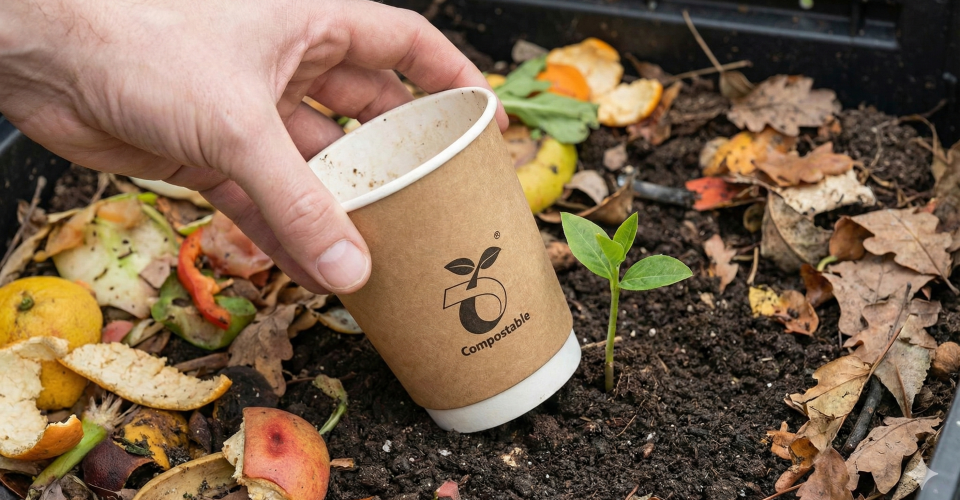
Many food and beverage packages are marketed as eco friendly, yet most still rely on thin plastic linings to perform basic functions like resisting grease or holding liquids. These plastic layers prevent the packaging from breaking down naturally and often lead to confusion for consumers and waste processors. Compostable coatings are the key factor that separates truly plastic free packaging from products that only appear sustainable on the surface.
This article explains what compostable coatings are, why they matter, how they work, and what to look for when evaluating compostable packaging claims.
Why Are Plastic Linings a Problem?
For decades, paper cups, bowls, and food boxes have depended on plastic linings made from polyethylene or polyethylene terephthalate. These materials are effective barriers against moisture and oil, but they create a major environmental issue.
Plastic lined paper products cannot be recycled through standard paper streams because the plastic layer is bonded to the fiber. They also cannot be composted because the plastic does not break down in composting conditions. Even when the paper portion decomposes, the plastic remains behind as fragments that persist in soil and water.
As regulations tighten and composting infrastructure expands, plastic lined packaging increasingly ends up in landfills. This undermines sustainability goals and contributes to long term pollution.
What Are Compostable Coatings Made Of?
Compostable coatings are designed to replace plastic linings while maintaining similar performance. Instead of fossil fuel based plastics, they rely on materials derived from renewable or naturally occurring sources.
Which Materials Are Commonly Used?
PLA, which is derived from fermented plant sugars such as corn or sugarcane
PHA, which is produced by microbial fermentation
Water based or bio resin coatings made from starches, cellulose, or other plant polymers
These materials are engineered to break down under composting conditions into water, carbon dioxide, and organic matter. They do not leave behind microplastics or toxic residues when processed in certified composting facilities.
How Do Compostable Coatings Work?
A common concern is whether compostable coatings can match the performance of traditional plastic linings. Modern compostable coatings are designed to create an effective barrier against grease, oil, and moisture while still allowing the product to decompose.
The coating forms a thin protective layer on the fiber surface. This layer limits liquid absorption during use but allows oxygen and microbial activity once the product enters a composting environment. This balance is essential for both food safety and compostability.
Many compostable coated products are tested under ASTM D6868 standards. This certification confirms that the coating and the fiber substrate can compost together within a defined timeframe without harming the quality of the resulting compost.
Are Compostable Coatings Food Safe?
Compostable coatings used in food packaging must meet food contact safety requirements. Reputable manufacturers test their coatings to ensure they do not transfer odors, flavors, or harmful substances to food.
In terms of shelf life, compostable coated packaging now performs on par with plastic lined alternatives for most food service applications. Hot foods, cold beverages, and oily meals can all be safely contained when the correct coating formulation is used.
This performance parity is one reason compostable coatings have moved beyond niche use and into large scale adoption.
Who Is Using Compostable Coatings Today?
Several major food service brands have already transitioned away from plastic lined packaging. Chains such as Chipotle and Panera Bread now use compostable lined bowls, cups, and clamshells across many locations.
These shifts have reduced plastic waste by millions of pounds each year and simplified waste sorting for customers and staff. In facilities where industrial composting is available, compostable packaging allows food waste and packaging to be processed together.
This real world use demonstrates that compostable coatings are no longer experimental. They are a practical solution that works at scale.
Are Compostable Coatings Cost Effective?
One of the main barriers to adoption has historically been cost. Compostable coatings often cost slightly more per unit than plastic linings. However, the cost gap has narrowed significantly in recent years.
When factoring in lower landfill fees, improved compliance with local regulations, and reduced contamination of recycling streams, the overall cost difference becomes smaller. According to Packaging Insights 2025, increased production capacity has led to annual price reductions of roughly 5 to 8 percent.
For brands operating in regions with composting mandates or plastic bans, compostable coatings also reduce the risk of fines and future redesign costs.
How Can You Identify Truly Compostable Packaging?
Not all paper packaging labeled as compostable meets recognized standards. Verification is critical. Certifications provide assurance that both the coating and the base material have been tested together.
Which Certifications Should You Look For?
BPI certification
TÜV Austria certification
ASTM D6868 compliance
Supplier technical sheets should specify the coating type and compostability conditions. Clear labeling also helps waste handlers and consumers dispose of packaging correctly.
FAQs
Are compostable coatings water resistant?
Yes. Compostable coatings are engineered to resist water, oils, and grease during normal use while still breaking down in composting environments.
Can compostable coatings be printed on?
Yes. They can be printed using soy based or water based inks that maintain overall compostability.
How do you verify compostability?
Check for third party certifications such as BPI, TÜV Austria, or compliance with ASTM D6868 listed in product specifications.
Do compostable coatings require industrial composting?
Most certified compostable coatings are designed for industrial composting, where controlled heat and microbial activity are present. Home compostability depends on the specific material and should be confirmed with the supplier.
Can compostable coated packaging be recycled with paper?
No. Compostable coated packaging should not be placed in paper recycling streams. It is intended for composting systems, not recycling, to avoid contamination.
